Somewhere in your notes app is the exact sentence you need — a professor's answer to a question about the exam, a research subject's exact phrasing on a sensitive topic, a source's precise quote from an interview three weeks ago. You know it's in there. Finding it means re-listening to fifty minutes of audio, or scrubbing a transcript looking for a phrase you can only half-remember.
That's the wrong way to search a recording. You shouldn't have to know the exact words to find the exact words.
Ask the note a question instead of searching it
Open any saved note in IA Voice Notes and ask it something in plain language — "what did she say about eigenvalues," "did he mention a deadline," "what was the interviewee's answer about funding." The answer comes back grounded in that specific note's actual transcript and summary, not a generic AI response pulled from general knowledge. It's answering from what was actually said, in that recording, because that's the only thing it's looking at.
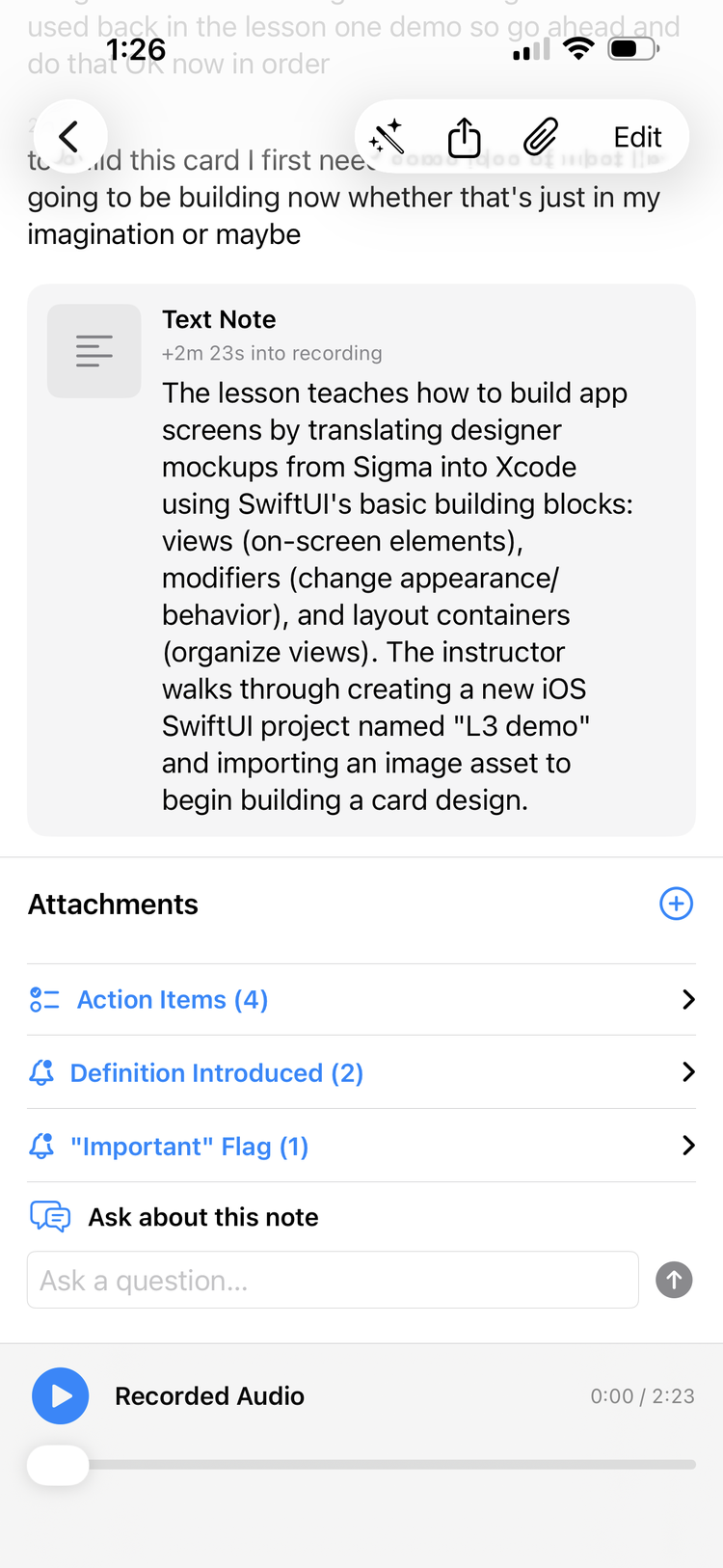
That distinction matters. This isn't a chatbot bolted onto your notes that might guess plausibly. It's a question answered from a transcript that exists, about a conversation that actually happened, which is what makes the answer trustworthy enough to actually use — in a study session, in a research write-up, in a follow-up email to a source.
Where this actually saves time
Exam review, days before a test, when you vaguely remember a proof being explained but not which of six lectures covered it — ask the note instead of re-listening to all six.
Qualitative research, going back through a stack of interview recordings looking for what different subjects said about the same theme — ask each note directly instead of re-transcribing your own transcripts by hand into a spreadsheet.
Long recordings in general — a two-hour lecture, a ninety-minute interview — where the four sentences you need exist somewhere in there, but "somewhere in a two-hour recording" isn't a place you want to search manually.
The takeaway
"I know it's in here somewhere" isn't good enough when you actually need the answer. Q&A over a note replaces that search with a direct question, answered in seconds, grounded in what was really said — a citation from your own recording, not a guess.
Related Reading
-
Lecture to Study Guide: Real-Time Transcription Meets AI Summaries
Real-time transcription during the lecture, an AI summary the moment it ends, and Q&A over the note when exam week arrives.
-
From Recording to Recap in One Tap
A smart title, a clean summary, and an exportable file the moment you stop recording — how automatic recaps replace twenty minutes of write-up.
IA Voice Notes: notes that listen. Free to download, Pro available for $0.99.
Download Free